
How to Let Conflict Deepen Your Connection Instead of Destroying It
Mia was telling her husband about a rough day at work when he glanced down at his phone.
“You’re not even listening to me,” Mia said in a harsh tone.
“I’m listening. I was just checking something,” Jordan said, matching the sharpness of her tone.
“You always do this.”
Within a few minutes, they weren’t talking about the phone anymore. She started going down the list: every time she’d felt unheard or let down in the last three years, every inadequacy she could name. Jordan defended himself against each one. Then came the low blow: “If I’m so terrible, just divorce me.” After that, a full day of silence in a house where two people who love each other walked around like roommates in a bad mood.
That’s a couple I recently sat down with. I’ll call them Mia and Jordan (names and details changed). Afterward, Mia told me, “I just wanted him to know that what I was telling him mattered to me.”
Here’s what I told them, and what I’ll tell you. All couples fight. I’d be worried if you didn’t. I find that what matters most in fighting and conflict is how you repair after.
Most of us never learned that part. We learned how to argue. Some of us learned to keep the peace at any cost. Others learned to go quiet, walk away, or pretend nothing happened. Almost nobody was taught how to come back together after something painful.
That skill is called repair, and it can be learned.
What a Rupture Is
A rupture is a moment when the connection between you feels strained or broken. Sometimes it’s a heated argument. Sometimes it’s the silence afterward, when you’re sitting on the same couch and feel miles apart.
It usually starts small. An unanswered text. A distracted response. A chore that landed on you again. You bring it up because you want to feel seen. Your partner hears criticism and defends themselves, which leaves you feeling even less understood, so you push harder. They pull away. Now you’re arguing about your tone, their attitude, and something that happened three years ago.
You wanted connection. Now you’re both trying to prove your point.
Who Is Having the Argument?
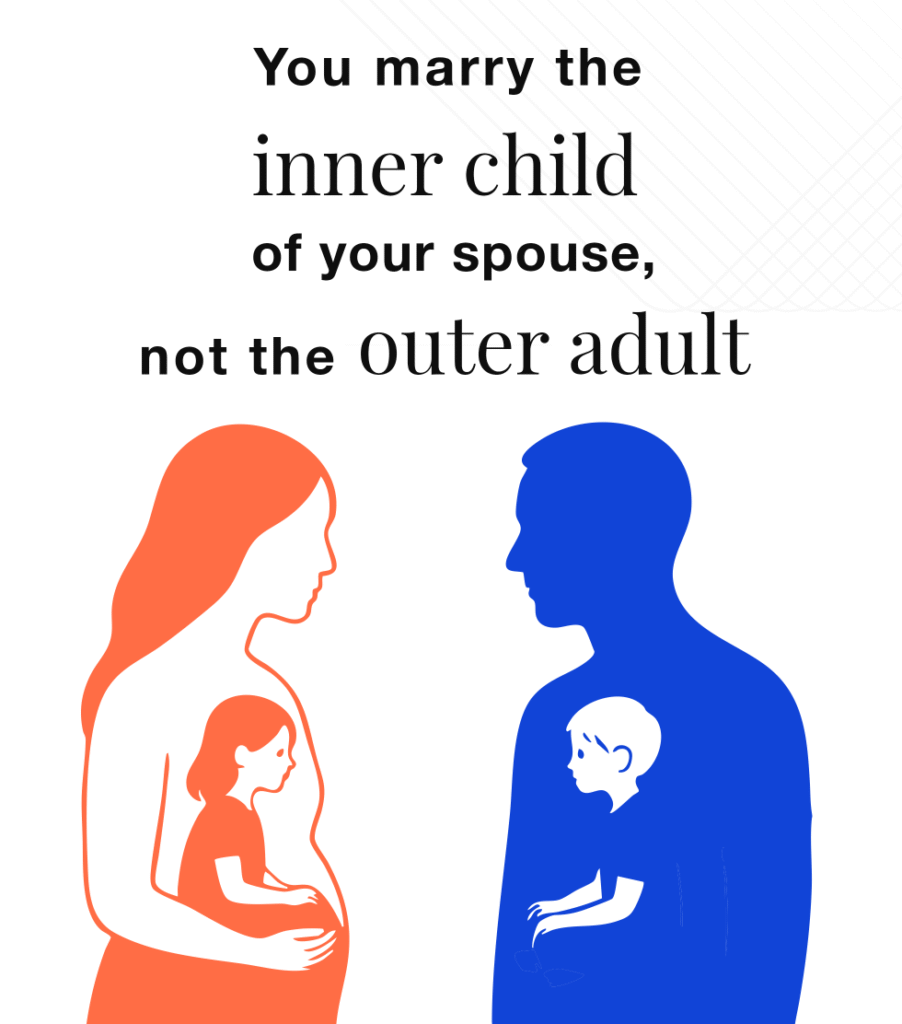
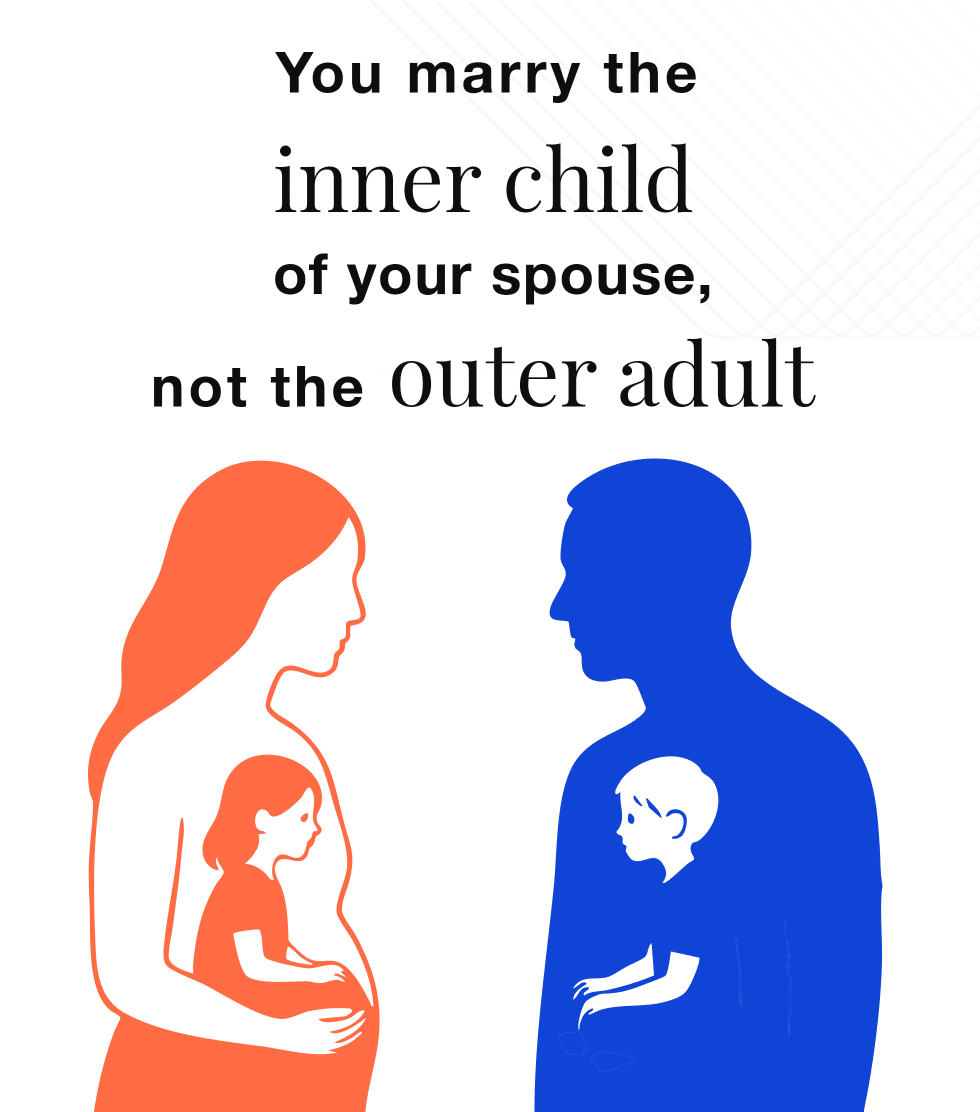
There’s a saying: you marry the inner child of your spouse, not the outer adult.
In parts work, we sometimes call this the wounded child part, a younger, vulnerable piece of you that still carries an old hurt or fear. You can be a capable, successful adult and still have a part of you that’s terrified of being left, dismissed, controlled, or not being enough, even if you can’t put words to it.
When something in the present touches that fear, your reaction gets bigger than the moment in front of you. An unanswered message feels like being forgotten. Feedback feels like being told you aren’t enough. A request for space feels like being abandoned.
For Mia, a glance at a phone landed on a very familiar feeling of being unimportant. A younger part of her heard you don’t matter and went to work protecting her the only way it knew how: criticism first, then shutting down. Jordan heard criticism, felt like he’d failed again, and defended himself.
On Jordan’s side, something just as old was getting stirred up. When Mia started listing everything he’d gotten wrong, he didn’t hear a wife who wanted his attention. He heard that he was failing her again. A lot of men know this feeling well. Underneath the defensiveness is shame, that quiet voice that says I can’t get this right, I’m not enough. And when shame shows up, many of us either fight back or shut down, because both feel safer than sitting in it.
Before long, two wounded five-year-olds are going at it, and both of them feel completely justified.
Calling that younger part of you a wounded child isn’t an insult. It’s a way to get curious about what’s happening inside you, and that curiosity gives you a chance to choose your next move.
Stepping Into Your Adult Self
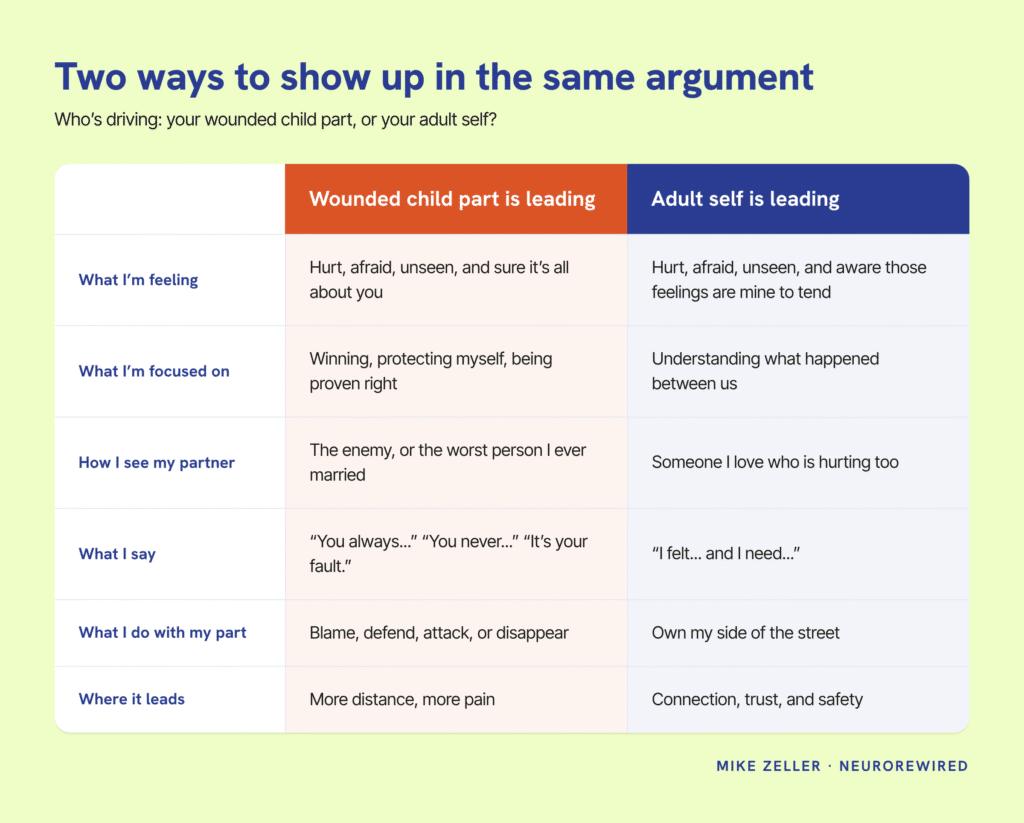
There’s another part of you, too: the grounded adult who can hold your hurt without being run by it. This is the part that can say, “I’m triggered right now, and I still care about you.”
Repair isn’t about never getting activated. You will get activated in your relationship. Repair is about noticing when a younger part has grabbed the wheel and then choosing to step back into your adult self, the one who can listen, own your side, and stay curious about your partner.
Your adult self doesn’t scold the wounded child or push it away. It turns toward it, the way a steady grown-up would with a scared kid: I see you’re scared, and I’ve got you. Let me handle this conversation.
A few ways to tell who’s driving:
- Is my body tight, my voice rising, my stomach in knots? That’s usually the wounded child.
- Am I trying to win and keep score, or trying to understand?
- Could I ask my partner a real question right now and actually want the answer?
What Repair Looks Like
Repair begins with being willing to understand what happened between you. That means listening to your partner’s experience, naming your own honestly, and owning what you contributed.
It also means making room for two experiences of the same moment. “I wasn’t trying to dismiss you” and “I felt dismissed” can both be true. Once you can hold both, there’s something to work with.
Here’s where I’d start.
Pause, with a plan to return. If you’re raising your voice, repeating yourself, or can’t hear a word your partner says, stop and say so: “I want to work through this with you, and I’m too worked up to listen well right now. Can we take twenty minutes and come back at seven?” Use the time to settle yourself. Walk, breathe, look around the room. A pause with a return time protects the conversation. A pause with no explanation just feels like leaving.
Get curious about your own reaction. Before listing everything your partner did wrong, ask yourself what hurt, what you assumed it meant, and whether the feeling is a familiar one. Underneath anger there’s often a fear of not mattering. Underneath defensiveness, embarrassment. Mia later put it this way: “When you looked at your phone while I was talking, I felt unimportant. I wanted your attention, and I came at you with criticism instead of asking for it.” And what she wishes she’d said that night: “This is important to me. Could you put your phone down for a few minutes? I really want to feel heard.”
Listen to understand. Let your partner finish. Ask, “What was the hardest part of that for you?” Then say back what you heard before you correct a single detail. If there’s more underneath, take turns emptying the bucket: one person talks about what they’ve been carrying, the other reflects it back, then you switch.
Own your side of the street. “I’m sorry you feel that way” leaves the other person holding the whole thing. “I interrupted you and called you unreasonable. That was hurtful, and I’m sorry” names what actually happened. You don’t have to accept blame for everything to own your part.
Agree on one thing that will change. Make it specific enough to practice. Phones away for important conversations. Asking before assuming. Naming a break and saying when you’ll be back. Then follow through, because that’s what rebuilds trust.
Once you both feel heard, let warmth come back at an honest pace. A hug, if you both want one. A walk, a meal, a little humor you both enjoy. Remember what you appreciate about each other. That part is easy to lose in the middle of a fight, and it’s a big part of what you’re fighting for.
Staying Connected Without Abandoning Yourself
You can approach your partner with empathy and still have a boundary. You can understand why they reacted and still say, “It isn’t okay to speak to me that way.”
Repair takes willingness from both people. One person can’t do all the listening, apologizing, and changing indefinitely.
One important note: if a relationship includes intimidation, threats, coercion, or violence, safety and individual support come first. The practices in this post are for disagreements where both people can participate safely.
Pathways to Misery & Happiness
Take a look at the Couples Guide below, and keep it somewhere you’ll see it.
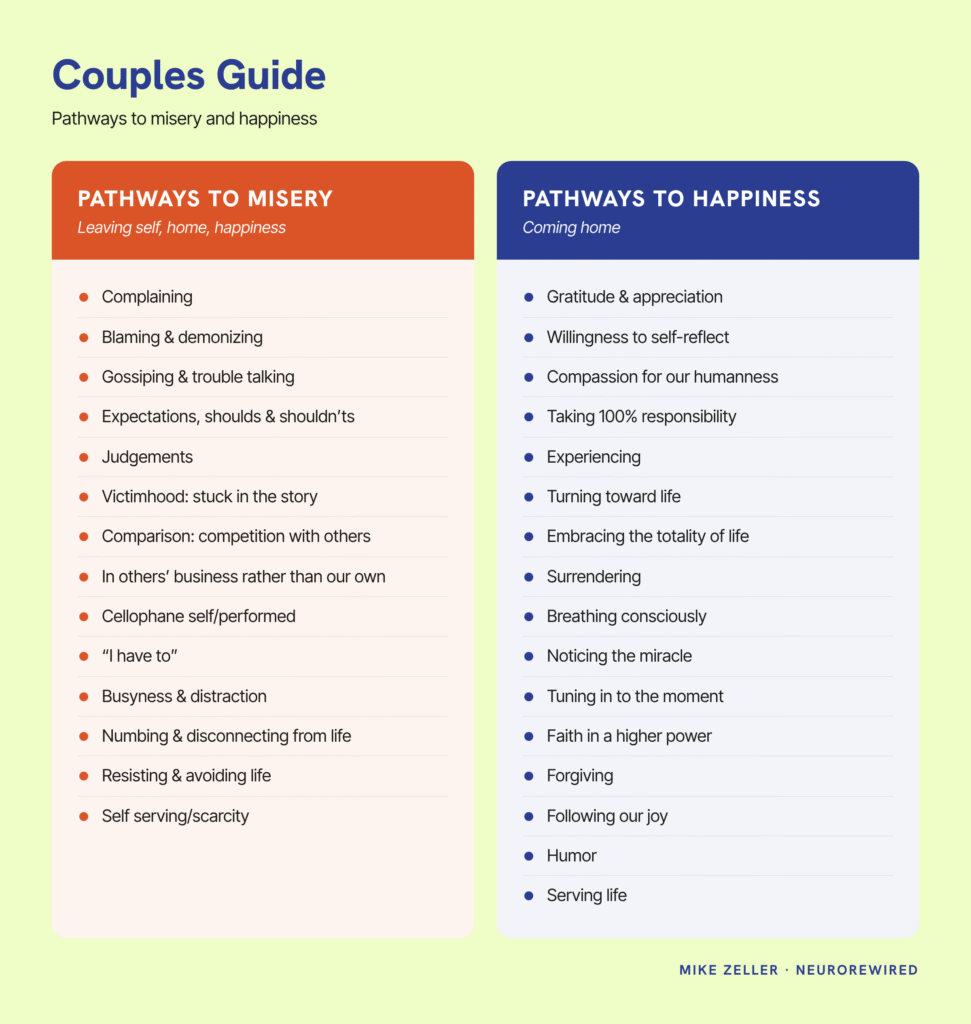
The left side shows the pathways to misery: complaining, blaming and demonizing, judgments, expectations and “shoulds,” getting stuck in the story, numbing out. The right side shows the pathways to happiness: gratitude, willingness to self-reflect, compassion for our humanness, forgiving, humor.
Catch yourself on the left side? No need to beat yourself up. Just notice it, take a pause if needed, and take one step to the right.
And when you see “taking 100% responsibility,” I mean owning your own reactions and your side of the street. That doesn’t make the whole fight your fault.
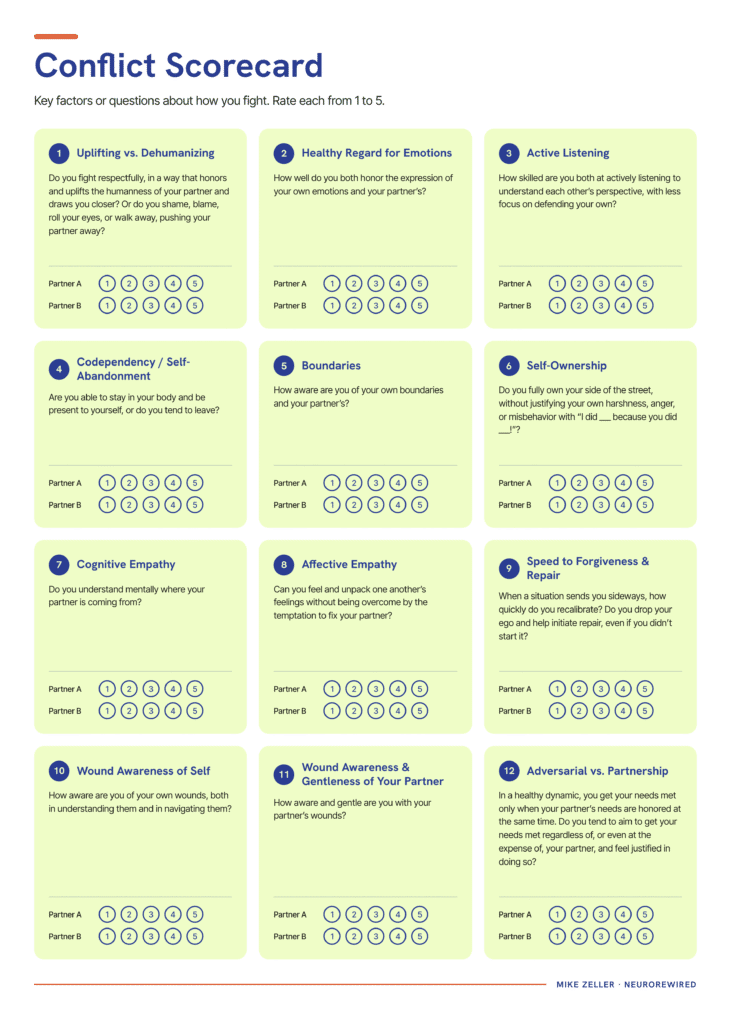
The Conflict Scorecard
Want a clearer picture of how the two of you handle conflict? Go through these twelve questions on your own, then compare notes with your partner. This isn’t about a perfect score. It’s about seeing where you’re already strong and where you have room for improvement.
A Different Way to Come Back Together
The next time you notice a familiar argument starting, see if you can catch yourself before the pattern takes over.
Take a breath. Say what you’re really feeling, even if it’s just “I’m hurt.” Then ask your partner a question you actually want the answer to.
“I’m feeling hurt, and I want to understand what happened.”
“I can see that my response made this harder.”
“Can we try that conversation again?”
You may need more than one attempt. Some hurts take time, and trust grows through what you consistently do after the conversation. Each time you come back together, you’re building an empathy bridge, a way back to each other that gets a little stronger every time you cross it. Here’s how to build it:
Acknowledge. Let your partner know you see that they’re hurting, before you explain or defend anything. “I can see this really hurt you.” You don’t have to agree with every detail to acknowledge what they’re feeling.
Reflect. Say back what you heard in your own words, then check: “Did I get that right?” This is the step most of us skip, and it’s the one that helps your partner actually feel heard.
Dig. Get curious about what’s underneath. “What did that feel like for you?” “Has that feeling come up before?” This is often where you find the wounded child part, and where real understanding happens.
Every time you acknowledge, reflect, and dig, you give your relationship another experience of coming back together.
As for Mia and Jordan, they’re still doing the work, and it’s showing. Mia has started asking for what she needs instead of criticizing Jordan for not giving it. And when she does fall into old patterns, Jordan is learning not to take it on as shame or as proof that he’s failing her. He can just hear what she’s asking for. They still have hard moments. They aren’t perfect. The difference is that they notice sooner when a wounded child part is showing up, and they can build the empathy bridge and let their adult selves lead. They find their way back faster now.
If you and your partner keep landing in the same fight and want support finding your way back to each other, my team would love to connect with you. Lacey is our lead facilitator, and she does our first discovery calls personally. She’ll get to know you, your story, and what you’re hoping for. Together, you’ll figure out the best path forward.
In your corner,
Mike
P.S. The next time your partner glances at their phone mid-story, try smiling and saying, “Hey, I want your eyes for this one.” Repair can start with a little humor.